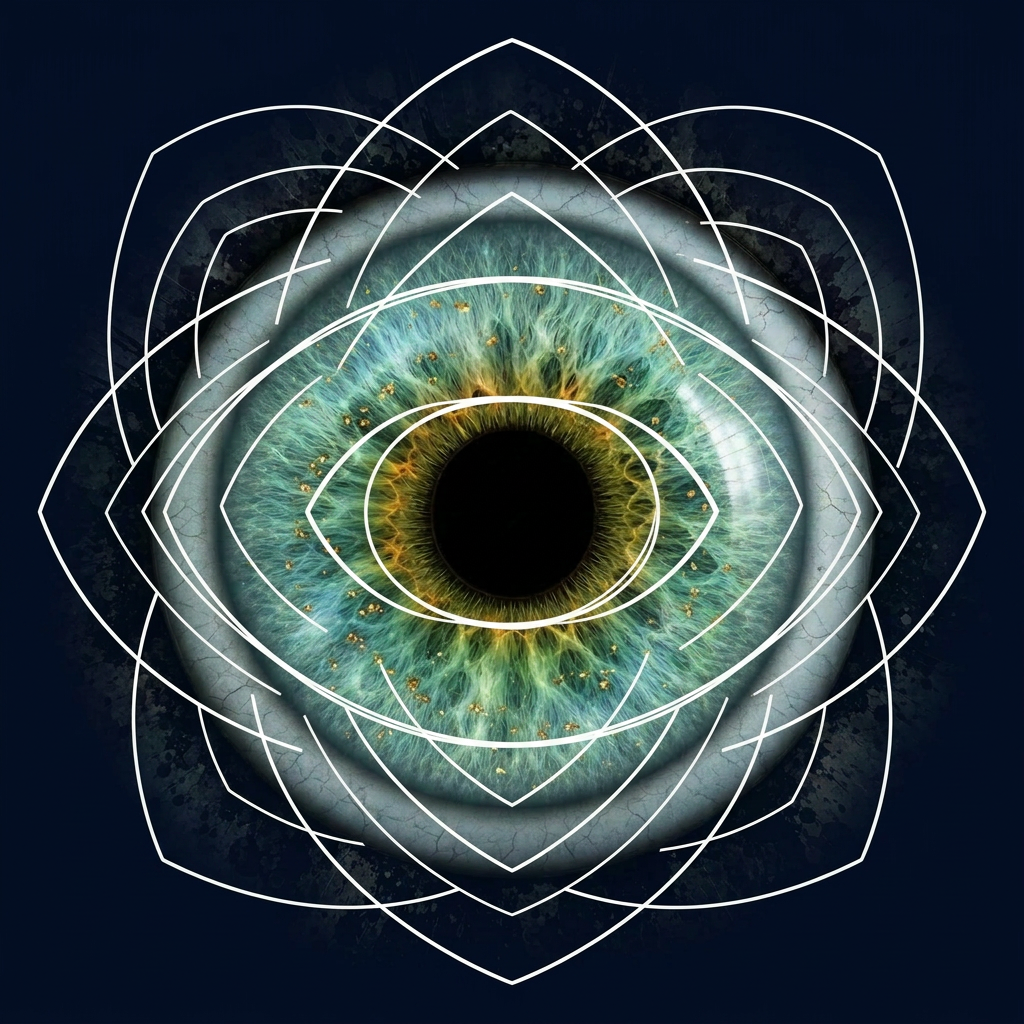
Match from a photo
Upload a close-up of your eye. The image is sent to AI for color analysis only — nothing is stored.
A mindful note about the photo match. When you upload a photo, it is sent to an AI model for one-time color analysis. Like any cloud computation, this uses energy and water — roughly the equivalent of charging a phone for a few minutes. Your image is never stored, saved, or used to train anything. We share this openly so you can choose with awareness.
Photo is analyzed for color only. This is not a medical, genetic, or identity assessment.
Refine to your eyes
Adjust the pigments — the rendering and the spectrum match update live.
The spectrum
Sorted from highest melanin to lowest. Click any iris for the science behind it.
Patterns and unique features
Beyond color, every iris has structure — rays, rings, crypts, flecks. Here's what those patterns are and what they actually mean (and don't mean).
Stromal rays (sunburst pattern)
also called Sunray iris, radial stromal striations
Lighter or darker spokes radiating from the pupil outward toward the limbus, like sunbeams.
Cause: Variation in stromal fiber density and pigment along the radial collagen bundles. Light reaching the deeper stroma is scattered differently along each ray.
What it indicates: Purely structural — a hallmark of low-to-medium melanin eyes (blue, green, hazel). Aesthetic trait, not linked to any health condition.
How common: Common in light eyes, almost invisible in dark brown.
Mystic reading
A literal sun behind the pupil. Folklore reads it as a soul that arrived with its own light — radiant, generative, hard to dim.
Human Design · Resonant with a defined Sacral or G Center — life-force as visible direction.
Astrology · Pure Solar signature; Leo. The chart point that wants to be seen so others can find their way by it.
Crypts of Fuchs
also called Fuchs' crypts
Diamond- or oval-shaped openings in the anterior iris near the pupil — visible as small darker pits.
Cause: Local thinning of the anterior border layer of the iris during development, exposing deeper, more pigmented tissue underneath.
What it indicates: Linked to the SEMA3A gene. More crypts correlate with a more 'open,' less uniform iris texture. No disease association.
How common: Almost everyone has a few; prominent crypts appear in roughly a third of light-eyed people.
Mystic reading
Small doorways into a deeper layer. The eye reads as porous — as if the soul left openings on purpose for the world to come in.
Human Design · Resonant with an open Head and open Spleen — receptive to wonder, intuitive about what's hidden.
Astrology · Neptune touches; 12th-house themes. The keyholes of the dreaming mind.
Contraction furrows
also called Schwalbe's contraction lines
Curved concentric lines circling the outer iris, like growth rings on a tree.
Cause: Folds in the iris stroma created by repeated pupil dilation and contraction over a lifetime.
What it indicates: Associated with the TFAP2B gene. Tend to deepen with age. Weakly correlated in studies with extraversion, but the effect is small and not predictive.
How common: Very common, more visible with age and in lighter eyes.
Mystic reading
Tree-rings inside the eye. A record of every time the light changed and the body responded — ancestral memory written in the iris.
Human Design · Resonant with a defined Root — the pressure of time turned into character.
Astrology · Saturn's signature. Chronos, lineage, the patience that builds rings.
Wolfflin nodules
also called Brushfield-like spots
Small, pale, slightly raised dots arranged in a ring around the outer iris.
Cause: Focal areas of stromal hyperplasia — extra connective tissue on the anterior iris surface.
What it indicates: A normal variant. Visually similar to true Brushfield spots (which occur in trisomy 21), but on their own indicate nothing medical.
How common: Roughly a quarter of light-eyed people; masked in dark brown irises.
Mystic reading
A ring of pearls around the iris — old symbol of a soul that has been polished by what it has been through. Quiet ornament rather than loud beauty.
Human Design · Resonant with a defined Spleen and open Will — refined intuition, integrity that doesn't need to advertise.
Astrology · Venus in air; Libra. Aesthetic intelligence as a spiritual practice.
Central heterochromia
also called Pupillary-ring heterochromia, gold/amber ring
An inner ring around the pupil that is a different color from the outer iris — typically gold or amber inside a green or blue eye.
Cause: Higher melanin (often pheomelanin) and pooled lipochrome in the iris tissue closest to the pupil, with less pigment in the outer stroma.
What it indicates: Almost always cosmetic and present from birth. A true two-tone ring that appears suddenly in adulthood warrants an eye exam.
How common: Uncommon — single-digit percentages globally.
Mystic reading
A small sun haloing the pupil. Many traditions call this the 'soul star' — the eye's own inner flame, the lit candle behind the door.
Human Design · Resonant with a defined Solar Plexus and Will Center — emotional truth fused with personal authority.
Astrology · Sun conjunct or aspecting Venus; Leo with a Cancer moon. Sovereign warmth wrapped around the heart.
Sectoral heterochromia
also called Partial heterochromia
A wedge or 'slice' of a different color in one iris — for example a brown patch in an otherwise blue eye.
Cause: A small population of melanocytes in that sector produces more or less pigment than the rest of the iris, usually from a developmental mosaic.
What it indicates: Almost always benign and congenital. New sectoral changes can rarely follow trauma, inflammation, or pigmentary glaucoma and should be checked.
How common: Rare — well under 1% of people.
Mystic reading
A door cut into the iris. The eye reads as a soul living more than one life in one body — a witch-mark in some traditions, a luck-mark in others.
Human Design · Resonant with a split-definition chart — designed for bridging, translating, and holding more than one truth at once.
Astrology · Mercury–Uranus contacts; Gemini, Aquarius. The herald and the heretic.
Complete heterochromia
also called Heterochromia iridum
Each eye is a distinctly different color (for example one blue, one brown).
Cause: Different melanin levels in each iris, from genetic mosaicism, Waardenburg syndrome, Horner syndrome, or early-life injury.
What it indicates: Most often a harmless inherited trait. Late-onset cases, or pairings with hearing or pupil changes, deserve a workup.
How common: Estimated under 1% worldwide.
Mystic reading
One eye for the seen world, one for the unseen. Folklore across cultures called this the gaze of the seer, the changeling, the half-fae.
Human Design · Often a split or triple-split definition — wired to bring two systems into conversation that don't normally meet.
Astrology · Strong Mercury–Neptune mix; 3rd/12th house emphasis. Messenger of dreams.
Iris nevus
also called Iris freckle, pigment spot
A small, flat or slightly raised dark spot on the iris surface — usually brown.
Cause: A local cluster of melanocytes producing extra pigment, similar to a freckle or mole on skin.
What it indicates: Almost always benign and stable. Spots that grow, distort the pupil, or change color should be evaluated; iris melanoma is rare but possible.
How common: Freckles are very common; defined nevi appear in roughly 5% of adults.
Mystic reading
A birth-mark in the eye. Read in many lineages as a soul-mark — a remembered place from a previous life, or a single drop of ink the soul brought through on purpose.
Human Design · Resonant with a defined Spleen — instinctive memory, the body's archive.
Astrology · South Node touches; karmic carry-over. A small souvenir.
Limbal ring
also called Corneal limbus pigmentation
The dark ring at the very edge of the iris where it meets the white of the eye.
Cause: Pigment and stromal density at the iris periphery, plus the optical edge of the cornea.
What it indicates: Thickest in youth and fades with age, which is why a strong limbal ring is widely perceived as healthy or youthful. No clinical significance on its own.
How common: Universal — but very pronounced rings are uncommon.
Mystic reading
The threshold of the iris — a drawn boundary between self and world. A strong limbal ring is read as a soul with clear edges: porous when it chooses, sealed when it must be.
Human Design · Resonant with a defined Spleen and defined Heart — clean boundaries, the gentle no.
Astrology · Saturn well-placed; Capricorn. The architect of the inner room.
Iris flecks
also called Gold flecks, brown flecks, lipochrome spots
Small, discrete patches of warmer color (gold, amber, or brown) scattered through the iris.
Cause: Focal clusters of pheomelanin or lipochrome in the anterior stroma. Unlike a nevus, flecks are usually multiple and smaller.
What it indicates: Cosmetic only. More common in hazel and green eyes where lower background melanin lets them stand out.
How common: Very common in hazel and green; uncommon in pure blue; masked in dark brown.
Mystic reading
Embers in the iris — sparks the soul carried through. Older star-lore reads gold flecks as 'stardust held back from the body.'
Human Design · Resonant with a defined Solar Plexus — warmth that flares without warning.
Astrology · Sun–Jupiter touches; Leo, Sagittarius. The generous, kindling self.
Stromal mottling (watercolor washes)
also called Stained-glass iris, watercolor streaks
Soft, irregular patches or jagged 'lightning-bolt' streaks of lighter and darker color bleeding across the iris — like watercolor stains rather than discrete flecks or a clean ring.
Cause: Uneven density of the anterior stroma combined with patchy melanocyte distribution. Where the stroma thins, more Rayleigh-scattered blue/green leaks through; where pigment pools, the iris reads darker.
What it indicates: Purely a structural and pigmentary trait — most common in low-to-medium melanin eyes (hazel, green, teal, light blue). One of the markers of a 'kaleidoscope' iris. No medical significance.
How common: Pronounced washes are uncommon — far more typical of hazel, green, and teal eyes than blue or dark brown.
Mystic reading
A stained-glass window for an eye. The kaleidoscope iris is read as a dreamer's mark — a soul that perceives in layers and refuses to flatten into one tone.
Human Design · Resonant with an open Head, open Ajna, and a defined Throat — wired to receive many signals and translate them into image.
Astrology · Strong Neptune and Moon; Pisces, Cancer. The artist, the empath, the lucid dreamer.
Educational only. Sudden changes in iris pattern, color, or pupil shape deserve an in-person exam by an eye care professional.
About the science
Iris color isn't a single pigment — it's a stack. Two melanins (eumelanin, the brown-black, and pheomelanin, the warm red-yellow) sit in the stroma alongside yellow lipochrome (a xanthophyll). Beneath them all, the stroma itself scatters short-wavelength light — the same Rayleigh scattering that makes the sky blue. The mix you see depends on how much of each pigment is present and how dense the stromal mesh is.
- Eumelanin — absorbs almost all light. The more of it, the closer to black-brown.
- Pheomelanin — warm red-yellow pigment shared with red hair.
- Lipochrome — yellow xanthophyll. Combined with Rayleigh blue it produces green.
- Structural blue — Rayleigh scattering inside the stroma. Not a pigment; it's an optical effect.
